
Growing Beauty
What Am I Really Offering?

Of all that Paulo Coelho’s The Alchemist has to offer, it’s the opening pages — not the treasure, not the journey, not even the Personal Legend — that move me the most.
Before Santiago sets out, Coelho begins with a revision of a myth we thought we knew:
“The alchemist picked up a book that someone in the caravan had brought. Leafing through the pages, he found a story about Narcissus… ‘I weep for Narcissus,’ the lake said, ‘but I never noticed that Narcissus was beautiful. I weep because, each time he knelt beside my banks, I could see, in the depths of his eyes, my own beauty reflected.’”
We’ve always focused on Narcissus — the youth who drowned chasing his own reflection. But Coelho turns our gaze to the lake, and offers a quieter, more haunting revelation:
The lake had come to believe its beauty existed only in the eyes of the one looking back.
That’s where my journey as an artist began — not with Narcissus, but with the lake.
The Mirror and the Maker
For years, I existed as a reflective surface.
Often feeling trapped in an overweight body, I was called “other,” while my art was called “beautiful.”
I was praised for what I could create — but not always seen for who I was.
I absorbed the contradiction without question, measuring my value by how well I could reflect what others wanted to see.
And for a long time, it worked.
Or so I thought.
Then came COVID. My portrait business of fifteen years was forced to close temporarily. And in that sudden stillness, I was gifted something I hadn’t had in years:
Time — to return to my roots, to create not for clients, but for myself.
Of course, one could argue that my portrait work is a reflection of my own beauty — my ability to see the best in others, to highlight that quiet spark each person carries.
But now, for the first time in a long time, the question shifted from:
“How can I please?”
to
“What do I want to say?”
It didn’t take long to realize how much I’d been hiding behind the camera.
While I loved photographing families, in part, I’d been avoiding my own work in the world.
That instinct — to tend to others first — was deeply ingrained.
As a child, I was taught to prioritize the needs of everyone else. But the more I created, the more a quiet question began to surface:
Could I be beautiful, too?
The Turning
The last five years have felt like the turning of a giant ship.
Painfully slow.
Sometimes exhilarating.
Sometimes terrifying.
Both liberating and disorienting.
At the beginning of the pandemic, the first tulips I had ever planted began to emerge.
I brought home all my photography equipment from the studio and began photographing them — as if they were families.
I created small scenes, imagined dynamics, told myself stories about their relationships.
Some were shy.
Some were bold.
Some demanded light.
Others seemed to lean into one another for support.
Of course, I was projecting.
Past family struggles. Things I’d witnessed over the years.
But mostly, I was celebrating each flower for its own essence.
And in doing so, I was secretly asking:
Can I learn to celebrate mine?
The Self-Portrait
Over time, I became good at growing flowers.
This past week, I brought hundreds of tulips from my garden into the studio.
For five days, I photographed their glorious blooms.
By the end, the petals — once upright, proud, illuminated — had begun to collapse across my workspace.
They were nearing the end. And yet, they were still so beautiful.
Dying, yes.
But not done.
At the end of each long day, I took a self-portrait.
It became a ritual.
A quiet marking.
A way to remember who I was becoming.
There’s one image I return to often.
I’m cradling a bundle of tulips — fully bloomed, as open as they will ever be.
The lighting is stark, moody, black and white.
My hands look skeletal — almost ghostly — though in life, they are full and strong.
And yet… that’s what struck me:
The image holds both truths.
The bloom and the vanishing.
The strength and the surrender.
The artist and the exhaustion.
The beauty that asks something of you — and the cost of answering.
I hadn’t planned it.
I simply sat down with the light still set for the flowers, held them with the grace they had offered me, and let the moment tell the truth.
What Is This Offering?
Sometimes I wonder:
What am I offering when I share these images?
Not because I doubt the work —
but because I care deeply about the why behind it.
And I’ve come to believe this:
I’m not offering the image.
I’m offering a way of being.
A way of being with beauty.
A way of being with time.
A way of being with yourself when you’re no longer performing.
This isn’t about being seen.
It’s about seeing — with tenderness, with reverence, with truth.
This is the gift:
Permission to care, even when it hurts.
To be tired and still show up.
To hold what is fleeting and still call it beautiful.
To let yourself be witnessed — not only at your peak, but in your unraveling.
From Reflection to Depth
This is the essence of Growing Beauty:
The shift from reflecting what others expect, to embodying what is real.
It’s the moment the lake stops waiting for a face to appear in its waters,
and begins to understand the depth of its own gaze.
It’s the moment a fallen petal becomes a dance.
It’s the moment you realize your worth does not lie in how perfectly you reflect the world —
but in how you transform what enters your depths.
We are not mirrors.
We are oceans.
And perhaps the most generous thing we can offer the world
is not the performance of perfection —
but the presence of truth.
🎥 Behind the Scenes
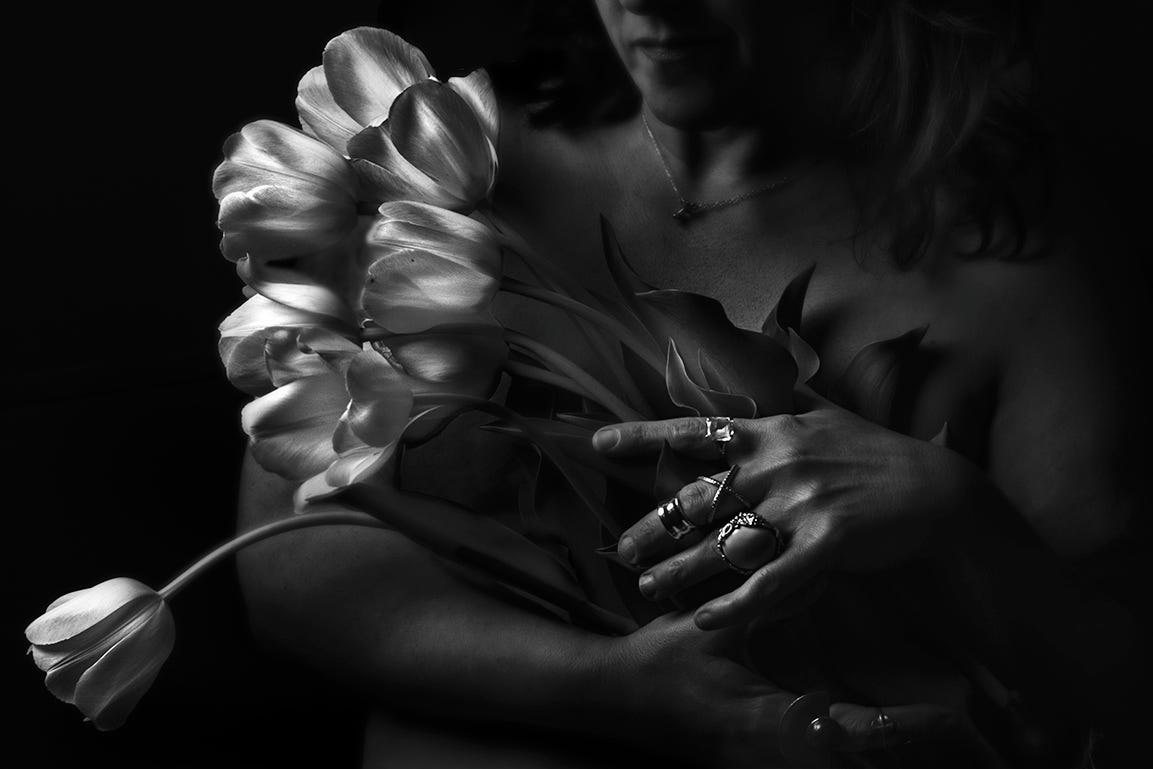
One of last week’s self portraits— a quiet moment of witness and wonder
Below is a short behind-the-scenes video of me filming (yes, filming... more to come:) the tulips in my studio last week.
Below: 5 years ago/Covid Shutdown. Behind the scenes: Creating out of our home kitchen with my first tulip garden. Began selling prints and packaging them on our dining room table.


💬 I’d love to hear from you…
If this piece resonated, I’d love to know:
Where are you learning to grow beauty in your own life?
In the quiet moments, in the unseen shifts, in the places you’re no longer hiding?
Your reflections are always welcome — and deeply felt.